
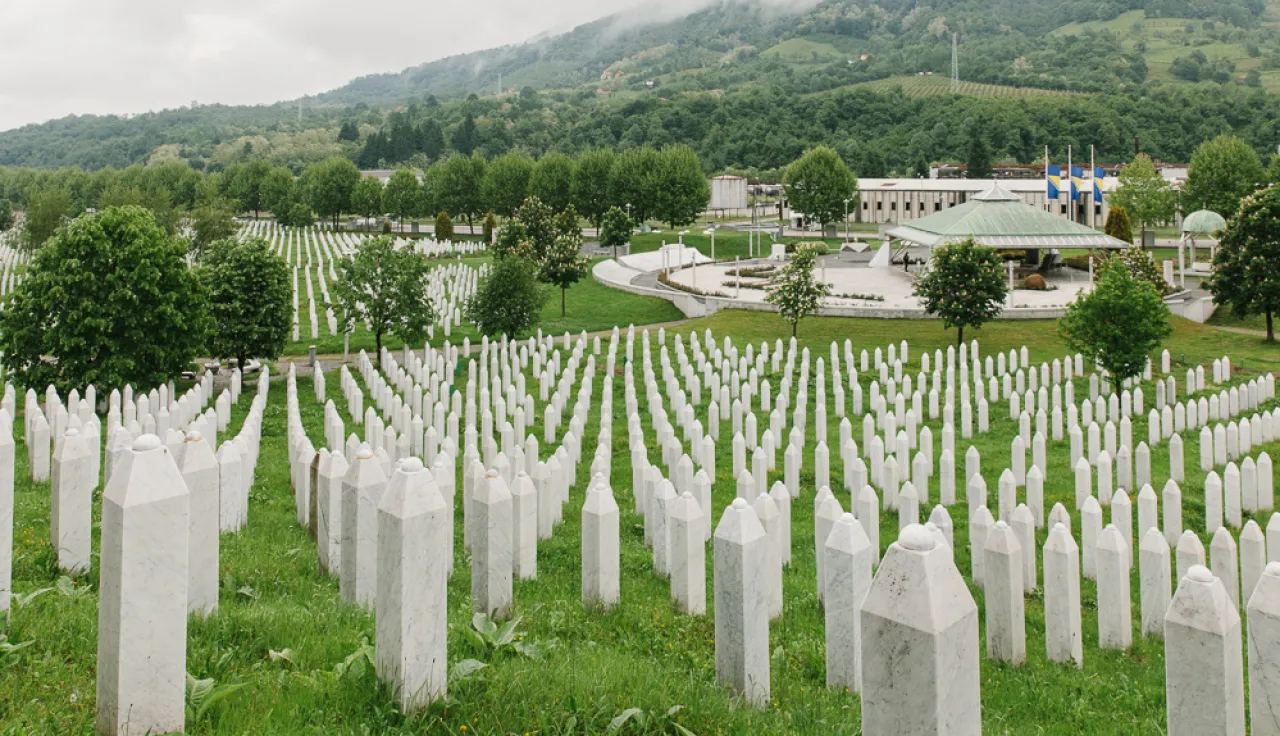
Every July, when the sun warms the valleys of eastern Bosnia, a painful forensic ritual begins. Whilst much of Europe marks the peak of summer, a mother in Srebrenica prepares to bury her child. She does not receive a complete skeleton to lay to rest. Instead, she will bury a single bone – a shattered tibia, perhaps a fragment of a skull.
This is the enduring, physical reality of the Srebrenica Genocide, the most lethal atrocity on European soil since World War II. For the surviving Bosnian Muslim (Bosniak) women, the injustice did not conclude with the signing of the Dayton Peace Agreement in late 1995. More than three decades later, the forensic search for the deceased remains an active, daily struggle, highlighting a catastrophic failure of international protection, the cold precision of forensic science, and a persistent political battle against historical denial.
The Promised Safe Zone and the Strategic Failure
The tragedy of Srebrenica is fundamentally a failure of international security guarantees. In April 1993, facing an aggressive siege by Bosnian Serb forces who were actively conducting ‘ethnic cleansing’ across eastern Bosnia, Srebrenica was declared a ‘safe area’ under United Nations Security Council Resolution 819. Displaced Bosniak families flocked to the enclave, trusting that the presence of Dutch UN peacekeepers (Dutchbat) and the mandate of international law would guarantee their survival.
On 11 July 1995, the Army of Republika Srpska (VRS), commanded by General Ratko Mladić, overran Srebrenica. The lightly armed Dutch peacekeepers offered no military resistance. The UN-designated safe zone was instantly compromised, leaving civilians with two critical options: seek refuge at the UN peacekeeping headquarters in nearby Potočari, or attempt a 100-kilometre trek through hostile, heavily forested terrain towards government-held territory in Tuzla.
Systematic Demographics and Mass Execution
At the UN base in Potočari, the Serb forces executed a highly organised, demographic-based separation process. Under the guise of searching for combatants, soldiers systematically isolated Bosniak men and boys – some as young as twelve – from the women and young children. Families were assured that these measures were temporary and part of a standard prisoner-screening process.
“My youngest’s hands were wrapped around me whilst he said, ‘Mother, please go, I beg of you!’ As he said this, he clutched me tighter to him… that is something that I cannot forget.”
– Hatidža Mehmedović, a mother who subsequently lost her husband, Abdullah, and both her sons, Almir and Azmir.
For the thousands who attempted to escape through the forests, Serb forces established perimeter ambushes. Soldiers used captured UN vehicles, helmets, and uniforms to deceive the exhausted, dehydrated refugees into surrendering.
Over several days, more than 8,000 Bosniak Muslim men and boys were captured, bound, and executed. Forensic exhumations later conducted by the International Criminal Tribunal for the former Yugoslavia (ICTY) recovered hundreds of wire ligatures and blindfolds alongside the remains, scientifically disproving the revisionist narrative that these victims died in active combat.
Clandestine Exhumations and the Secondary Graves
The scale of the crime was compounded by a systematic, military-led cover-up operation. In late 1995, as international pressure grew and satellite imagery began revealing mass burial sites, the Bosnian Serb military used heavy excavation equipment to systematically exhume the primary mass graves.
Using bulldozers, they dismembered the remains of the victims, loaded them onto trucks, and reburied them across dozens of highly concealed ‘secondary’ and ‘tertiary’ mass graves miles away.
Because of this deliberate disruption of the sites, forensic teams have spent three decades matching DNA from fragmented remains. Through pioneering DNA technology, the International Commission on Missing Persons (ICMP) has successfully identified over 7,000 of the 8,000 victims.
Yet, because the bodies were so severely scattered, families are often left with a painful choice: bury a single identified bone today, or wait indefinitely in the hope that more of their loved one’s remains are found.
Facts and Figures: Srebrenica and the Forensic Struggle
The scale of the Srebrenica Genocide is documented by the ICTY, the International Court of Justice (ICJ), and the ICMP. The data reveals a highly organised execution and cover-up campaign:
| Category | Documented Figure (Approx.) | Notes |
| Total Verified Victims | 8,372+ | Calculated through identified remains and missing person reports. |
| Identified and Buried | 6,900+ | Laid to rest at the Potočari Memorial Centre. |
| Primary Mass Graves | 43+ | Original execution and initial burial sites. |
| Secondary/Tertiary Graves | 90+ | Hidden sites created during the military cover-up. |
| Convicted Individuals | 50+ | Sentenced by the ICTY and local Bosnian courts. |
Institutional Impunity and Systematic Denial
The 1995 Dayton Agreement ended the physical war, but left survivors to navigate deep trauma and administrative neglect. Many widows returned to rebuild their lives in Srebrenica, living alongside unprosecuted neighbours who participated in the wartime administration or stood guard during the roundups.
This environment is worsened by systematic political denial. Despite the landmark 2004 Radislav Krstić ruling officially establishing Srebrenica as a genocide, local authorities and regional narratives actively contest this truth. This denial acts as a secondary form of violence, erasing the historical record and denying survivors institutional acknowledgement of their loss.
The Cost of Inaction: The Broken Promise of ‘Never Again’
Srebrenica is not a static event confined to 1995; it is an active indictment of the international ‘Responsibility to Protect’ doctrine. The empty homes of eastern Bosnia and the fresh graves dug every July in Potočari expose the devastating reality of choosing geopolitical pragmatism over human life. When the enclave fell, the post-World War II vow of ‘Never Again’ was dismantled – not due to a lack of intelligence, but a failure of political will that left a targeted Muslim minority defenceless under a compromised UN mandate.
Today, as identity-based violence and state-sponsored blockades continue to unfold globally, Srebrenica remains a critical, unlearned lesson. With over 1,000 victims still missing in the Bosnian clay and revisionists weaponising denial with impunity, this tragedy endures. Srebrenica is not merely a historical memory; it is an active, ongoing warning of the catastrophic cost of global inaction.
Comments are closed